
Designers often choose inserts late in the packaging process.
That is where problems start. The insert controls how a product sits, moves, and appears. A weak choice affects protection, cost, and client satisfaction.
This guide explains the main types of custom inserts used in rigid boxes. It focuses on how designers actually think when selecting one for a client’s product.
You want to make a custom box to enhance the product’s presentation. But making it to complement the nature of the packaged product is a whole other new challenge.
One way to enhance the product’s protection & presentation is to offer inserts as an add-on option.
So the premise of this blog is to help you understand:
- Different categories of custom inserts
- Which type fits what product
- How can you choose between these options
Let’s explore this topic further so you can select a promising type of insert for your client’s product or perhaps yours.
Which Box Insert Fits Your Product?
Most brands pick inserts based on what looks good.
But if the insert doesn’t match the product’s needs, things go wrong.
Your item shifts during shipping.
Or it arrives damaged.
Or the box feels cheap when opened.
The fix?
Match the insert to what matters most—protection, presentation, or purpose.
Below are common insert types and when to use them.
| Insert Category | Material | Main Job | Best For | Trade-Off |
| Position-Control Inserts | Cardboard trays | Hold in place | Cosmetics, accessories | Won’t cushion drops |
| Shock-Absorbing Inserts | Foam or rubber | Protect from impact | Electronics, glass | Costs more |
| Presentation Inserts | Fabric or wood | Premium unboxing | Jewelry, luxury gifts | Takes up space |
| Sustainability Inserts | Molded pulp | Reduce waste | Eco-conscious brands | Limited shapes |
| Multi-Item Inserts | Dividers or trays | Separate products | Kits and sets | Little padding |
| Problem-Specific Inserts | Magnetic or snap-fit | Custom solutions | Reusable packaging | Needs exact design |

Different Options of Inserts
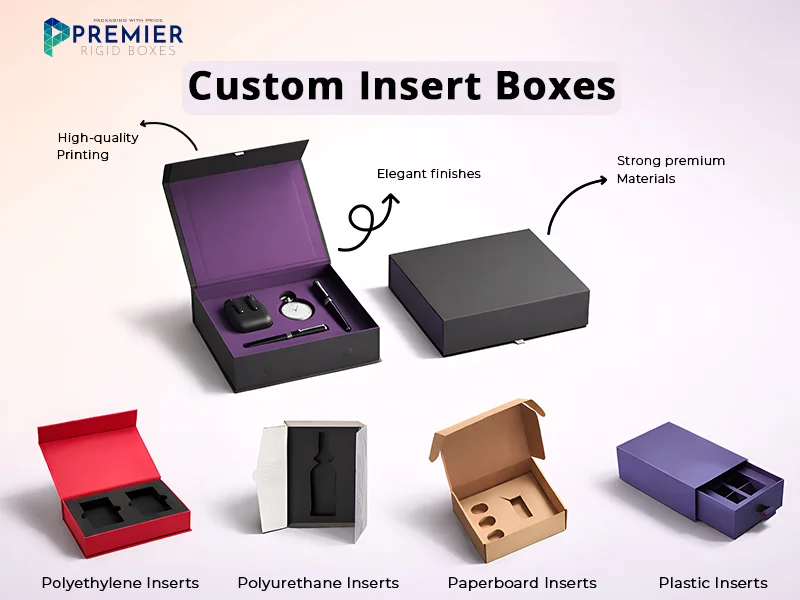
Customer products come in different shapes, styles, and sizes. Different products require different levels of support, presentation, and environmental consideration. And so do we have different insert options.
1. Polyethylene (PE) Foam Inserts
PE foam provides reliable shock absorption and is widely used for protective packaging.
- Best for: Electronics, tools, mid-range products requiring solid impact protection
- Strengths: Durable, moisture-resistant, cost-effective at volume
- Limitations: Coarser texture makes it less suitable for luxury presentation without additional covering
2. Polyurethane (PU) Foam Inserts
PU foam is softer and more comfortable than PE foam, making it a common choice for consumer electronics and accessories.
- Best for: Consumer electronics, cameras, accessories, products with complex shapes
- Strengths: Good contouring, widely available, moderate cost, can be die-cut or waterjet-cut to precise shapes
- Limitations: Open-cell structure makes it more susceptible to moisture and compression over time; less suitable for inserts opened and closed frequently
3. EVA Foam Inserts
EVA foam offers a smooth, dense surface with high durability under repeated use. It looks and feels more refined than standard PE or PU foam.
- Best for: Premium electronics, high-end cosmetic kits, jewelry packaging, collector’s editions
- Strengths: Smooth finish, excellent durability under repeated compression, premium appearance, good impact resistance
- Limitations: Less conformable than PU foam for complex irregular shapes; higher cost than standard foam options
4. Paperboard Inserts
Paperboard inserts are lightweight and structured. They are the most cost-effective option and work well for products that do not require impact absorption.
- Best for: Retail products, skincare sets, subscription boxes, multi-compartment trays
- Strengths: Lowest cost, lightweight, widely recyclable in standard streams when uncoated, easy to print and brand
- Limitations: Provides no shock absorption; unsuitable for fragile or high-value items. Important: Paperboard that is laminated, coated, or foil-stamped may not be accepted in standard municipal recycling streams. Verify the specific material specification with your supplier before making recyclability claims.
5. Molded Pulp Inserts
Molded pulp inserts are formed from recycled paper fiber — typically newsprint, cardboard, or sugarcane bagasse — and are compostable or recyclable depending on the binder used.
- Best for: Eco-conscious brands, natural skincare, sustainable product lines, brands with public sustainability commitments
- Strengths: Made from recycled content, biodegradable or compostable, supports circular packaging goals, improving in manufacturing quality and appearance
- Limitations: Structural molded pulp (thicker-walled, precision-formed) can achieve high protection levels — the idea that it offers only “moderate protection” is an oversimplification. Thin-wall molded pulp suits lighter products. Tooling costs for custom shapes can be high at low volumes.
6. Plastic Inserts (Blister or Tray Style)
Plastic trays — typically formed from PET, PVC, or PETG — offer clear product visibility and rigid, structured placement.
- Best for: Cosmetics, multi-item kits, small electronics, retail products where product visibility matters
- Strengths: Product is visible through clear material, precise compartmentalization, durable, and cost-effective at volume
- Limitations: Most single-use plastic trays are difficult to recycle in practice. If brand sustainability is an important positioning, this option warrants careful consideration.
7. Fabric-Wrapped Inserts
Fabric-lined inserts — typically foam or board cores wrapped in velvet, suede, satin, or microfiber — add softness and a distinctly luxurious feel.
- Best for: Jewelry, premium accessories, watches, collector’s edition products, gifting
- Strengths: Highest perceived value of all insert types, protects delicate finishes from scratching, strong brand impression
- Limitations: Highest cost; longer lead times; branding options on the insert surface itself are limited compared to printed paperboard

How to Choose the Right Insert for Your Product
From Premier Rigid Boxes, picking the right insert means thinking about several things at once.
Product Weight and Fragility
Heavy products require strong, dense inserts to prevent movement. Fragile items like glass, ceramics, or delicate instruments need soft, shock-absorbing foam rather than hard paperboard or plastic trays, which can transfer bumps rather than protect the product.
Shipping Conditions and Stress
An insert that holds a product on a shelf might not protect it in a box dropped from a few feet. If your products are delivered through a network, make sure the insert is tested for shipping. Standards such as ISTA 2A and ASTM D4169 are common test methods. Ask your packaging supplier if they do this testing or can help with it.
Brand Image
Luxury brands often choose EVA foam, fabric-covered inserts, or premium molded pulp for a high-end feel and look. Mid-market brands might mix paperboard with foam. The insert should match the price and story of the box outside.
Sustainability
If your brand promotes eco-friendliness, choose inserts that align with that promise. Molded pulp and plain paperboard are strong choices. Be careful claiming recyclability for coated paperboard or standard plastic trays—check with your supplier first.
Budget and Minimum Orders
Your budget affects both the cost per unit and the minimum order quantity. Paperboard and standard foam usually have the lowest minimums and need little or no special setup. Custom foam shapes, molded pulp, or fabric-covered inserts cost more upfront and usually require at least 500–2,000 units. Talk about this early with your supplier.
Branding on the Insert
Inserts can show brand colors, logos, or printed tissue paper. Paperboard and molded pulp are the easiest to print on. Fabric-covered inserts give a nice feel but limited print options. EVA and PU foam can be embossed or wrapped. If showing your brand on the insert is important, plan for it when picking the material.
Closing Remarks
So that’s the end of this blog. Hopefully, you have learned the stuff we promised earlier. Let’s recap the types of custom inserts we learned.
- Cardboard, paperboard, and plastic trays keep products from sliding around.
- Foam, rubber, and silicone help absorb shocks so fragile items don’t break.
- Fabric, wood, and metal inserts make the first-open moment feel more special and high-end.
- Molded pulp, bagasse, cork, and PLA are better for the environment, but they can limit shape and design options.
- Trays, partitions, and dividers keep sets and multi-item products neat and easy to handle.
- Magnetic, snap-fit, and mixed-material (hybrid) inserts solve unique or tricky packaging problems.
Let’s make sure what we do brings value to people who trust us to do a fine job.