
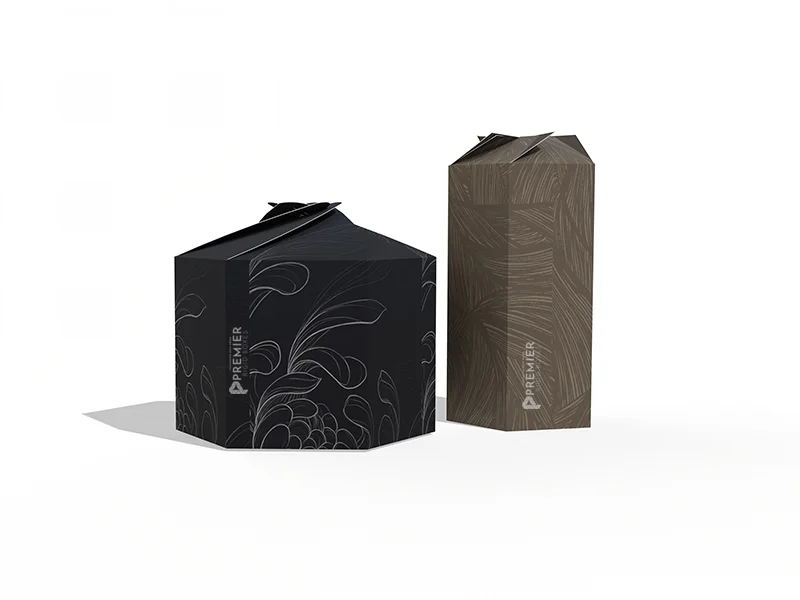
Designing custom twist top boxes in Pacdora means creating exact 2D dielines and 3D box shapes with a twist-lock that works well. This type of box is a great choice for brands that need a secure closure without glue or tools, like cosmetics and retail products. Getting the size right is very important. Even a small mistake, like more than 0.5 mm, can cause the lock to fail, tear the material, or make the lid too loose.
So that’s the reason this blog exists: to help you understand how to design this style of box in Pacdora.

Part one: Template selection for structural integrity
The foundation of a functional twist top box is the selection of a verified Folding Carton Style within the Pacdora Template Library.
- Action: Access the Pacdora dashboard and filter for twist top or interlocking lid structures.
- Selection criteria: Choose a template that matches the product’s geometric footprint. For example, a cube-style twist top is standard for skincare jars, while elongated structures suit bottled products.
- Importance: Starting with a pre-engineered dieline ensures that the tapered tabs and receiver slots are mathematically aligned for a synchronized twist motion.
Part two: Defining dimensional parameters
Accurate dimensioning is mandatory to ensure the twist mechanism in custom twist top boxes operates without excessive friction or structural sagging.
- Measurement: Input the length, width, and depth of the primary product.
- Tolerance Buffer: Apply a 2 mm to 3 mm clearance (buffer) to the internal dimensions to accommodate product insertion and prevent side-wall bulging.
- Validation: Review the updated dieline in Pacdora to ensure the dust flaps and locking panels scale proportionally with the new dimensions.
Part three: Fine-tuning the twist lock mechanism
The twist lock is the primary functional component of the packaging. It requires specific adjustments to the locking tabs and panel scores.
- Dieline Inspection: Switch to the 2D view to examine the cut-and-crease lines.
- Mechanical Adjustment: If the 3D preview indicates a tight lock, reduce tab width by 0.5 mm.
- Simulation: Utilize the 3D Fold Animation tool to verify that the four top panels intersect and lock at the correct rotation angle.
Part four: Branding and vector artwork integration
Visual design must be applied without compromising the structural integrity of the fold lines and bleed zones.
- Artwork Upload: Import high-resolution Vector Graphics (AI or PDF) or raster images directly onto the 3D canvas.
- Safe Zone Alignment: Position logos and typography within the safe zones to avoid placement on score lines or perforations.
- Wrapping: Verify that background patterns wrap continuously across the side panels in the 3D Mockup view.
Part five: Exporting production-ready assets
Finalizing the design requires exporting files that meet commercial printing and die-cutting standards.
- Technical Check: Ensure Bleed Areas (typically 3 mm) extend beyond the cut lines to prevent unprinted edges.
- File Format: Export the final asset as a PDF or DXF file.
- Layer Management: The output must contain distinct layers for Cut Lines (solid), Fold Lines (dashed), and Artwork, allowing the printer to distinguish between structural and visual data.

Summary of Twist Top Box Design
Designing twist top boxes in Pacdora involves a sequence of selecting interlocking templates, setting precision dimensions, and validating mechanical tolerances. Key takeaways include:
- Success depends on the early alignment of dieline structures with product dimensions.
- Twist locks require a 0.5 mm tolerance adjustment for optimal functionality.
- Exporting layered PDF/DXF files with clear cut-and-fold indicators is essential for error-free manufacturing.
- A correctly designed box provides a high-end consumer experience through a secure and repeatable mechanical seal.
This blog was made possible with the help of our packaging designers and marketing team. We at Premier Rigid Boxes are making custom packaging solutions affordable, yet not lowering the quality standards. If you are interested in having a look at our custom twist top boxes, feel free to jump to our product pages. For quick estimates to learn how much it would cost to acquire personalized boxes, you can request a quote.

Frequently Asked Questions:
What is a twist top box in packaging design?
A twist top box is a type of folding box with four panels that lock into each other. It closes tightly without glue. These boxes are often used for premium items like cosmetic jars, candles, and sweets because they look high-end and feel special when opened.
What material thickness is best for twist top boxes?
The best material is SBS paperboard. A thickness of 18 pt to 24 pt works well. This gives the box enough strength to stay closed while still letting the top panels bend and fold easily.
How much extra space should I add to box size?
Add 2 mm to 3 mm extra space to the length, width, and height of your product. This helps the product fit well inside the box. It also stops the box from bulging or tearing when you close the top.
Do twist top boxes need glue or tape?
No, the top of the box does not need glue or tape. It stays closed by locking into place. However, the side of the box may still need glue when it is made.
What file formats are needed for printing?
Printers need vector files like PDF, AI, or DXF. These files should come from the dieline view in Pacdora. Make sure the file has clear layers for cut lines (solid, fold lines (dashed), and bleed area (at least 3 mm). This helps with clean cutting and correct print alignment.
Why use Pacdora for twist top design?
Pacdora helps you create these boxes faster. It can build the dieline for you and show a 3D preview of how the box will fold. This lets you check if everything works before you make a sample or start full production.